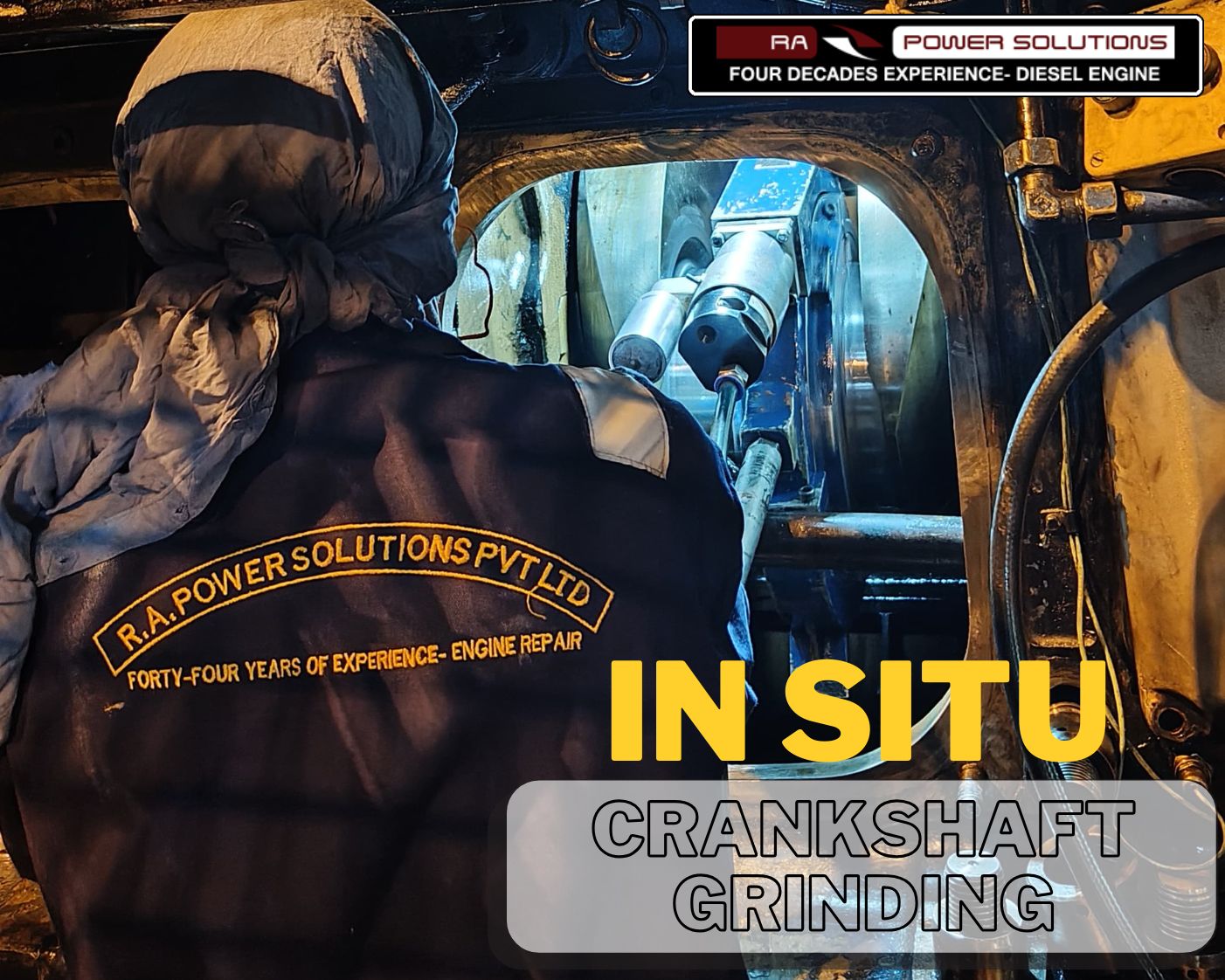
Marine engine crankshafts are subjected to continuous cyclic loading, fluctuating combustion pressures, motion vibrations, and lubrication-related stresses throughout their operational life. During my experience working on slow-speed and medium-speed marine diesel engines, I have found that timely in situ crankshaft grinding is often the most practical and technically sound solution for restoring damaged crankpins and main journals without removing the crankshaft from the engine.
Removing a crankshaft from a vessel is a time-consuming operation requiring extensive dismantling, dry docking, heavy lifting equipment, and prolonged vessel downtime. Modern on site crankshaft repair and reconditioning techniques allow damaged journals to be restored directly inside the engine block while maintaining OEM tolerances and class requirements.
Initial Inspection Before In Situ Crankshaft Grinding
Every successful repair begins with a detailed inspection. Before any machining operation is started, the crankshaft condition must be thoroughly evaluated to determine whether repair is technically feasible.
The inspection process includes:
- Visual inspection of crankpins and main journals
- Measurement of journal diameter
- Ovality and taper measurement
- Run-out and crankshaft alignment inspection
- Surface roughness evaluation
- Oil hole inspection
- Bearing contact pattern examination
- Lubrication failure analysis
- Fillet radius inspection
- Assessment of previous repairs
Only after these measurements are completed can the appropriate repair procedure be selected.
Crankshaft Crack Inspection and Grinding
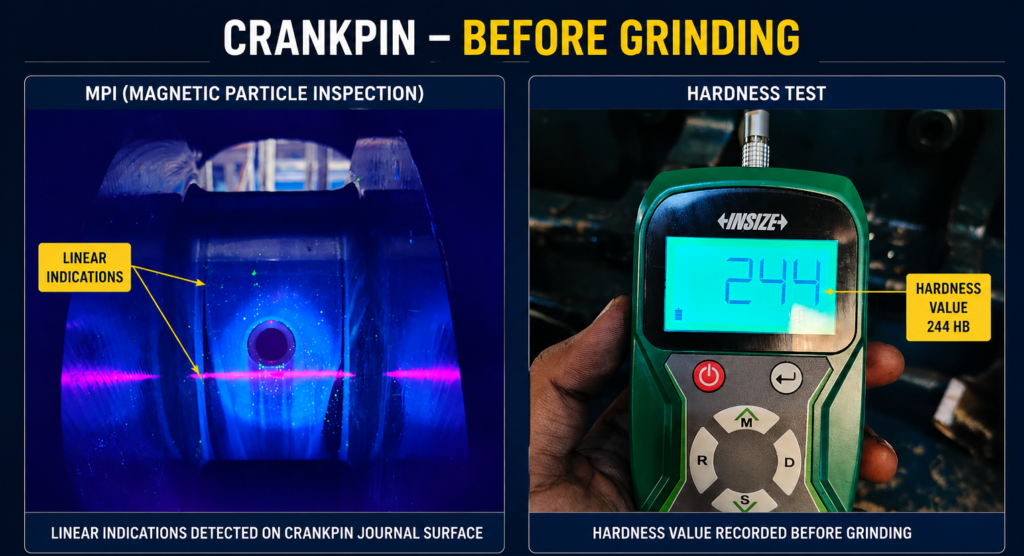
One of the most critical stages of crankshaft restoration is crankshaft crack inspection and grinding.
Before commencing grinding operations, every crankpin and main journal is inspected using approved Non-Destructive Testing (NDT) methods, including:
- Magnetic Particle Inspection (MPI)
- Dye Penetrant Testing (DPT)
- Ultrasonic testing where applicable
Particular attention is given to:
- Fillet radius
- Oil holes
- Journal edges
- Stress concentration areas
- Previous repair locations
If cracks are detected beyond OEM permissible limits, grinding alone cannot restore the crankshaft, and further engineering evaluation is required. When no structural defects are present, controlled grinding can proceed safely.
In Situ Grinding of Crankpin
The most common repair carried out onboard is in situ grinding of the crankpin.
After removing the damaged bearing shells and preparing the journal surface, specially designed orbital grinding equipment is mounted directly around the crankpin. The equipment rotates concentrically with the crankshaft while maintaining precise dimensional control throughout the grinding cycle.
During grinding, continuous measurements are taken to monitor:
- Journal diameter
- Cylindricity
- Taper
- Ovality
- Surface finish
- Fillet radius
Grinding is performed gradually to avoid thermal distortion while ensuring the finished journal remains within the manufacturer’s regrinding limits.
Crankshaft Grinding Main Journal
When excessive wear or scoring is observed on the main bearings, Crankshaft Grinding Main Journal becomes necessary.
Unlike crankpin repair, main journal grinding requires additional alignment verification because the main journals directly influence crankshaft geometry and engine bearing loads.
Throughout the machining process, engineers continuously verify:
- Main bearing alignment
- Journal concentricity
- Bearing housing condition
- Lubrication passages
- Surface finish
Proper restoration of the main journals ensures stable hydrodynamic lubrication and long bearing life after reassembly.
In Situ Crankshaft Machining
Modern in situ crankshaft machining allows highly accurate restoration of damaged journals without removing the crankshaft from the vessel.
The machining equipment is rigidly mounted around the crankshaft and incorporates precision feed mechanisms capable of producing controlled material removal while maintaining excellent dimensional accuracy.
Typical machining operations include:
- Journal reconditioning
- Radius correction
- Surface restoration
- Undersize machining
- Finish grinding
- Precision polishing
This method significantly reduces repair duration compared to conventional workshop repairs.
Inplace Crankshaft Machining
Inplace Crankshaft Machining eliminates the need for transporting the crankshaft to an external machine shop.
The complete repair is performed onboard, reducing:
- Dry dock requirements
- Heavy lifting operations
- Engine dismantling
- Transportation risks
- Vessel downtime
- Repair costs
This approach has become the preferred solution for many commercial vessels operating under tight schedules.
Grinding of Crankshaft Onsite
Professional grinding of the crankshaft onsite follows a carefully controlled engineering procedure.
The repair sequence generally includes:
- Initial inspection
- Dimensional measurement
- Crack inspection
- Bearing removal
- Machine installation
- Alignment verification
- Controlled grinding
- Radius finishing
- Journal polishing
- Dimensional inspection
- Surface finish verification
- Final documentation
Each stage is recorded to maintain complete traceability for vessel records and classification society requirements.
Crankshaft Grinding Onsite
Successful Crankshaft Grinding Onsite depends on precision rather than speed.
Throughout the repair, engineers continuously monitor:
- Journal temperature
- Grinding pressure
- Material removal rate
- Surface finish (Ra value)
- Journal geometry
- Oil clearance
- Bearing seating
The objective is to restore the crankshaft to OEM specifications while ensuring reliable engine operation after commissioning.
Onsite Journal Machining Services
Professional Onsite Journal Machining Services cover both crankpins and main journals across a wide range of marine engines.
These services typically include:
- Journal measurement
- Precision grinding
- Radius restoration
- Journal machining
- Journal polishing
- Bearing seating correction
- Dimensional verification
- Final inspection
Accurate journal geometry is essential for maintaining proper oil film thickness and preventing premature bearing failures.
In Situ Crankshaft Polishing
Following grinding operations, In Situ Crankshaft Polishing is carried out to achieve the specified surface finish.
Controlled polishing removes microscopic grinding marks while improving the journal’s ability to support a stable hydrodynamic oil film.
Final polishing also:
- Reduces friction
- Improves bearing bedding
- Minimizes wear
- Enhances lubrication performance
- Extends crankshaft service life
The finished journal is verified for surface roughness before final acceptance.
Crankshaft Grinding Repair Services on Vessel
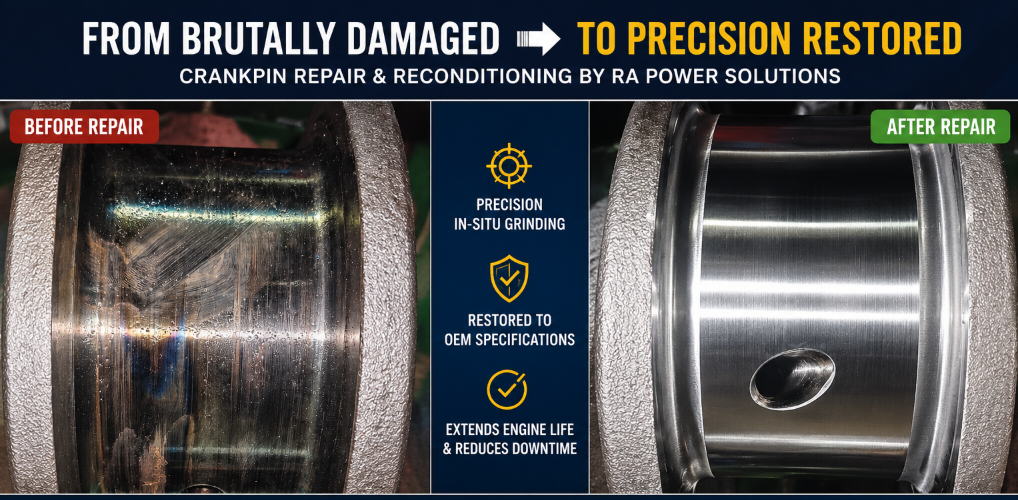
Modern crankshaft grinding repair services on vessels enable repairs to be completed while the engine remains installed onboard.
This approach offers several operational advantages:
- Minimal engine dismantling
- No crankshaft removal
- Reduced downtime
- Lower repair costs
- Faster return to service
- Compliance with OEM repair procedures
- Support during voyage or port stay, subject to operational conditions
These services are routinely performed on propulsion engines, auxiliary engines, generator engines, and compressor drive engines across various vessel types.
Vessel Crankshaft Repair
Every Vessel Crankshaft Repair project concludes with a comprehensive quality inspection before the engine is returned to operation.
The final inspection includes:
- Journal diameter verification
- Ovality confirmation
- Taper measurement
- Fillet radius inspection
- Surface finish measurement
- Bearing clearance verification
- Oil hole cleaning
- Crankshaft rotation check
- Final NDT where required
- Sea trial or operational testing
Only after all parameters comply with OEM recommendations is the repair considered complete.
RA Power Solutions has successfully repaired crankshafts of MAN B&W, Wärtsilä, Sulzer, MAK, Caterpillar, Daihatsu, Yanmar, Deutz, Pielstick, Himsen, Allen, Ruston, ABC, Bergen, Niigata, EMD, Cummins, and many other marine and generator engine models. Our in situ crankshaft grinding and repair services have been delivered in over 100 countries, serving ship owners, power plants, offshore operators, and industrial facilities worldwide.
We also specialize in the inspection, repair, rebabbitting, and manufacturing of main bearings, crankpin bearings, connecting rod bearings, thrust bearings, white metal (Babbitt) bearings and engine bearing bushes, providing complete rotating equipment and engine repair solutions from a single source.
For more information on onsite crankshaft repair, grinding of crankshaft, and crankshaft polishing please email us at rajshahani@rapowersolutions.com, or info@rapowersolutions.com, or call us at +91 9582647131 or +91 9810012383.
